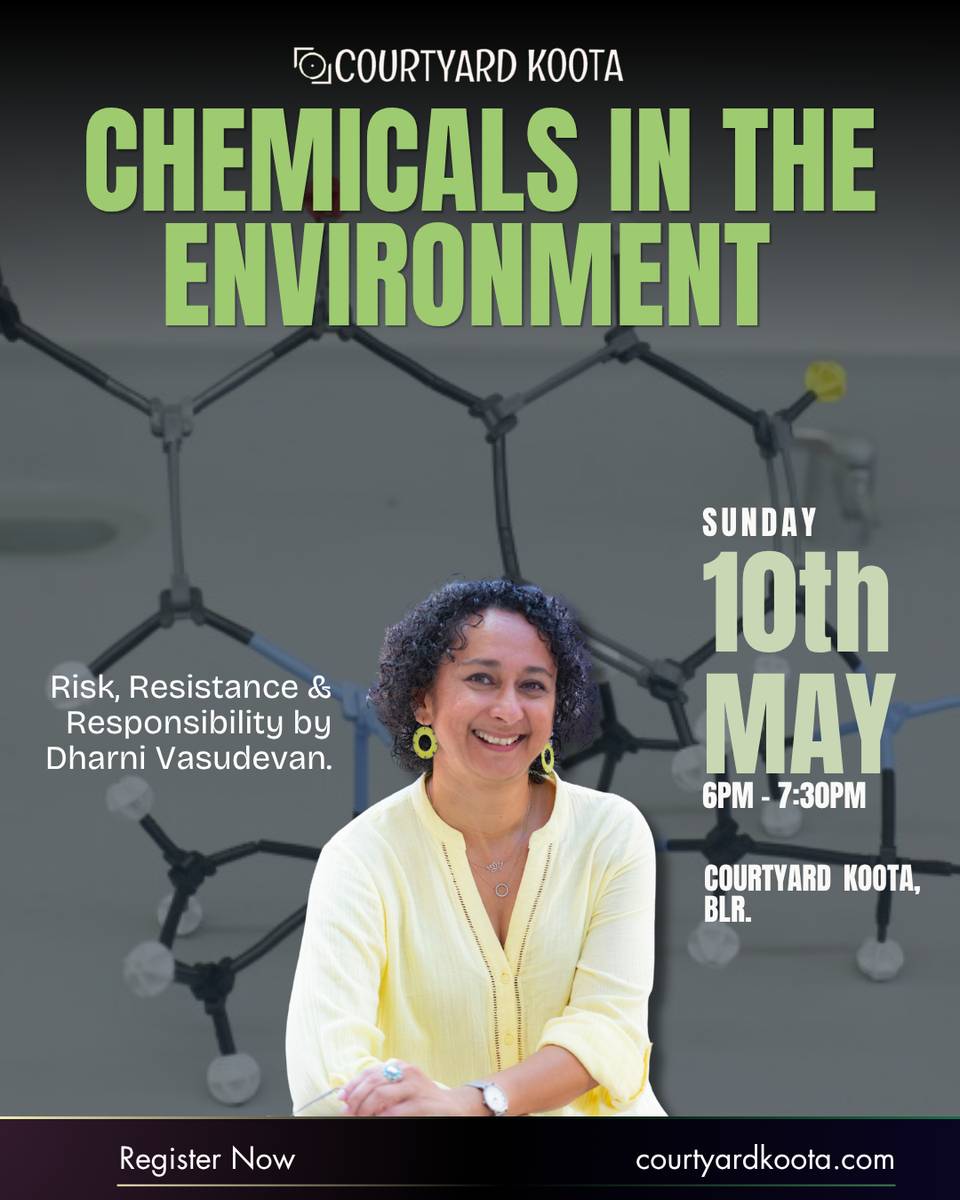
Chemicals in the environment: Risk, Resistance and Responsibility
Details
May 10 2026 to May 10 2026 6 p.m.
EVENT HAS ENDED
Price: Rs 100 Book/Buy
Where
Courtyard Koota
Ground floor, Good Earth Tarana Good Earth Malhar, near Rajarajeswari medical college Kambipura, Bengaluru, Karnataka 560074
Event Description
Excerpt:
Every day, we make quiet judgments about the water we drink, the food we eat, and the air we breathe—drawing on a deeper knowing about chemical safety than we often recognize. But what happens when chemicals escape into the environment, and who gets to decide what counts as safe? This talk invites you to explore the surprising connections between molecular structure and social structure, between scientific evidence and lived experience, and between the systems that produce chemical risk and the communities that refuse to accept it. This is an invitation to reflect, discuss, and discover together—you may find you already know more than you think, and that there is more cause for hope than you might expect.
About Dharni Vasudevan:
Dharni Vasudevan is a Professor of Chemistry and Environmental Studies at Bowdoin College. Her research concerns the environmental fate of chemicals, such as pharmaceuticals and pesticides, and her work focuses on the mechanisms by which these compounds and related model substructures interact with surfaces in soil and aquatic environments. She is jointly appointed to the Chemistry Department and Environmental Studies program at Bowdoin, and brings a interdisciplinary and collaborative lens to her teaching and research. A professor at Bowdoin since 2004, Vasudevan was the chair of the Department of Chemistry from 2014–2018, and then served as associate dean for faculty development and inclusion from 2020-2025. In 2013–2014, she was a visiting scientist in the Exposure, Epidemiology, and Risk Program at the Harvard School of Public Health. Prior to joining Bowdoin College, she was a professor at Duke University’s School of the Environment (1998-2003) and Science Policy Fellow at the American Chemical Society (1996-1998).
As an undergraduate student she really got hooked on environmental chemistry when I discovered that chemical structure dictates chemical properties and their ‘personalities,’ which in turn determines how they behave in the natural environment, which in turn impacts human and wildlife exposure to them. She received her bachelor’s degree in Environmental Engineering Science from the Massachusetts Institute of Technology, and her masters in Environmental Engineering and PhD in Environmental Chemistry from the Johns Hopkins University.
Age 14+
Upcoming events in Courtyard Koota