Resonance A Dialogue Between Veena and Bansuri
Details
Apr 21 2026 to Apr 21 2026 7 p.m.
Where
Bangalore International Centre
7 4th Main Rd, Stage 2, Domlur 560071
Event Description
The veena from Ayodhya meets the bansuri from a Mumbai gurukul. The mridangam of a dynasty meets the tabla of the first generation.
Some raagas on this programme belong to both Indian classical traditions, the same soul unfolding differently in each. Others belong exclusively to one. In the moments of improvisation, there are no boundaries between instrument and artist, North and South.
An evening of Carnatic and Hindustani music, in conversation. Samvad.
Supported by:
Performers
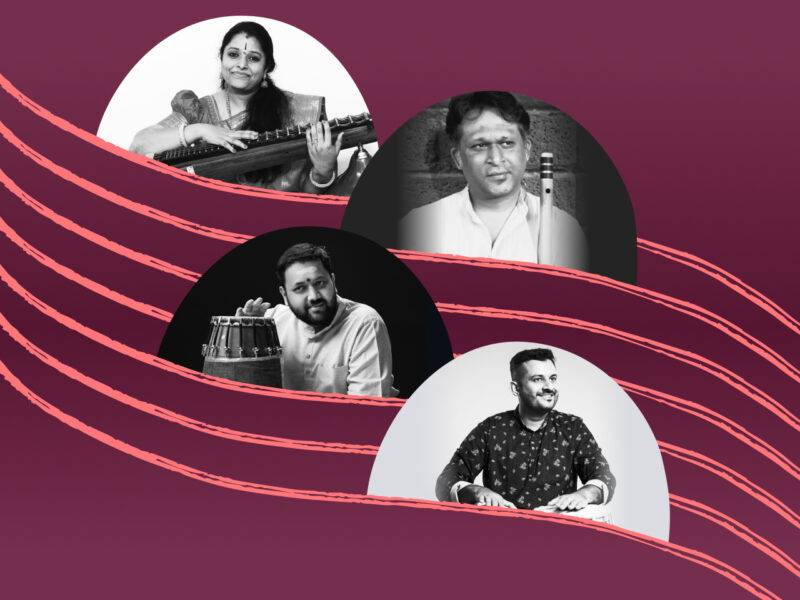
Shubha Santhosh
Veena
Shubha’s relationship with the veena began under the late Vid. H. Srinivasa Murthy Achar, and deepened through years of training with Vid. Smt. Sudha Vadiraj. Further mentorship from Mridanga Vidwan Sri H. S. Sudhindra added rhythmic dimension to her understanding, an unusual influence for a veena artist, and one that shows in the precision and clarity she is known for. Her tana renditions, in particular, have earned a reputation of their own.
What distinguishes Shubha is the breadth of her musical repertoire. She has performed at leading sabhas across India and abroad. She has composed, directed, and sung on numerous albums. She teaches, through the Shubha Santhosh Music Foundation, with the same seriousness she brings to the stage. The recognition has been consistent: ‘A’ graded AIR artist, Gold Medalist in MA from Bangalore University, First Class in Vidwat Grade, ICCR empanelled artist, Junior Fellowship 2017 from the Ministry of Culture, and a member of the Music Syllabus Committee for the Karnataka Secondary Education Board in 2016. Her most memorable performance was on January 22nd, 2024, when she represented Karnataka’s veena tradition at the Rama Lalla Pratishtapana in Ayodhya.
Sameer Rao
Bansuri
At age eleven, Sameer picked up the bansuri in Mysore. That single decision has taken him to concert halls across four continents. His first teacher was Pandit Veerabhadraiah Hiremath, who gave him his grounding. In 2002, he became a disciple of Padma Vibhushan Pandit Hari Prasad Chaurasia. For six years, from 2004 to 2010, Sameer lived and trained at the Vrindaban Gurukul in Mumbai, inside the full rigour of the Guru-Shishya Parampara. It was an education that went well beyond music.
Pandit Chaurasia’s trusted Sameer to manage and teach at the newly established Vrindaban Gurukul in Bhubaneswar, a responsibility he carried until 2012. Since then, Sameer has built a life that holds performance, composition, and teaching together. He is an ‘A’ graded AIR artist and ICCR empanelled performer, and has played across India and in China, Switzerland, Germany, France, Australia, Spain, South Korea, Norway, the UK, and the USA. His awards include the Surmani from Sur Singar Samsad Mumbai, Yuva Pratibha from the Directorate of Kannada and Culture, Nada Kishore from Nada Bramha Sangeeth Sabha Mysore, Samskrithika Saarathi from Natya Taranga Sagara, and the Award of Excellence from Guru Ganayogi Trust Chennai, among others.
He composes for albums, theatre, dance, and documentary film. Based in Mysore, he teaches a handful of dedicated students and remains visiting faculty at the Bhubaneswar Gurukul, still breathing through the bansuri, as he has since he was a boy.
Vinod Anoor
Mridangam
Vinod Anoor carries a lineage to his craft. As the fifth generation of the Anoor musical family, he grew up inside one of the most storied traditions in Carnatic percussion. He trained under Vidwan Rudrapatnam Satyakumar and his father, Vidwan Anoor R. Ananthakrishna Sharma, learning not just technique but the weight of what it means to uphold the name.
Eighteen years of concert experience across India and abroad have made him one of the most dynamic percussionists of his generation. The mridangam is his primary voice, but he speaks fluently in tabla, khanjari, dholak, pakhawaj, and chende, a range that has taken him well beyond the Carnatic stage. The accolades have followed: All India Radio National Award (2012), ‘A’ Grade Artist AIR (2021), Best Mridangam Artist by Karnataka Fine Arts Council (2015), Naada Yuva Puraskara (2021) from NaadaMaya Trust, Bengaluru.
In 2018, he crossed into entirely different territory, the Indo-German jazz collaboration Allgäu Meets India, which went on to win the German Jazz Prize. A musician comfortable in his tradition and curious beyond it. He continues to mentor students and support the Anoor Foundation’s work in keeping Indian classical arts alive.
Vignesh Kamath
Tabla
Vighnesh grew up in Mysuru with rhythm in his heart. His early training under T. Haridas Pai and Shri Bhimashankar Bidanur gave him the foundation. After completing his Engineering in Polymer Science, he picked up the tabla full time. He went on to earn an MA in Tabla from Bharati Vidyapeeth, Pune, the academic rigour sitting alongside the deeply personal tradition of taleem. Since 2011, Vighnesh has been under the advanced tutelage of Dr. Aneesh Pradhan, one of India’s foremost tabla maestros.
On stage, he has accompanied some of the most respected names in Hindustani classical music: Shubha Mudgal, Pt. Venkatesh Kumar, Devaki Pandit, Shaunak Abhisheki, Jayateerth Mevundi, among others. He has been part of Dhamaal, Dr. Aneesh Pradhan’s cross-cultural percussion ensemble of over 70 drummers, and performed at the Jackfruit Festival 2025 in Bengaluru. But perhaps what says most about him is what he built at home: Kalādhārā Music and Arts Academy in Koteshwar, Bengaluru, where he now passes on what was given to him.
Upcoming events in Bangalore International Centre