Science, Stewardship, and Solidarity - Celebrating the Life and Legacy of Madhav Gadgil (1942-2025)
Details
Jan 26 2026 to Jan 26 2026 6:30 p.m.
EVENT HAS ENDED
Where
Bangalore International Centre
7 4th Main Rd, Stage 2, Domlur 560071
Event Description
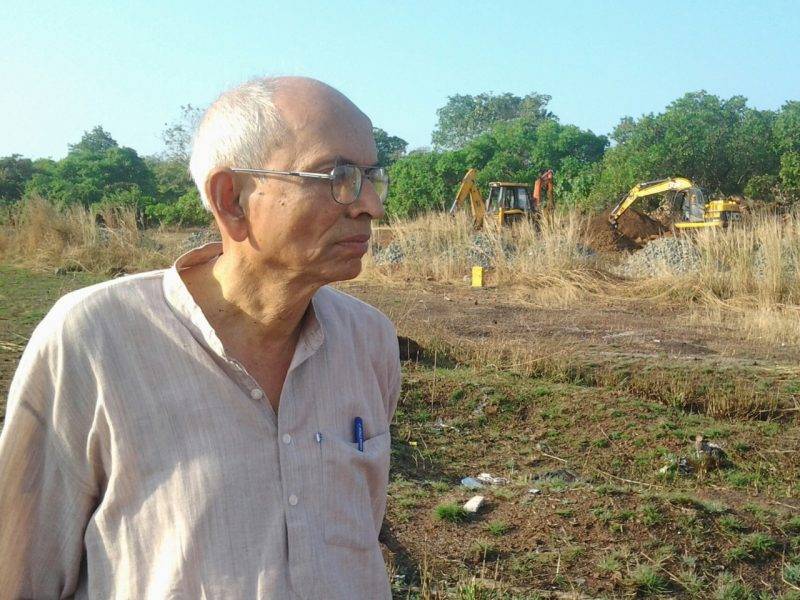
Madhav Gadgil (1942-2025) was the country’s pre-eminent ecologist, whose work and writing had a profound influence in shaping environmental policy and action in India. Educated in Pune, Mumbai and Harvard, Professor Gadgil spent more than three decades at the Indian Institute of Science in Bengaluru, where he founded the Centre for Ecological Sciences.
Professor Gadgil was the author of scientific papers that became ‘citation classics’, and of pioneering books on environmental history that are discussed three decades after their publication. He was also widely known for the report of a committee on the Western Ghats that he chaired, which presciently warned of the ecological disasters that would follow from unregulated mining, tourism and road construction in this vitally important mountain ecosystem. In the course of his rich and varied career Professor Gadgil conducted fieldwork in most of India’s states, acquiring an unparalleled knowledge of the country’s cultural and ecological diversity.
The Bangalore International Centre shall celebrate Madhav Gadgil’s life and legacy in a special memorial meeting held on 26th January. The date is appropriate; for Professor Gadgil himself had a deeply democratic sensibility, and embodied in his person the finest values of the Indian Republic. The speakers are two scientists, two economists, a journalist and a historian, all of whom knew Professor Gadgil and his work well.
Speakers
Harini Nagendra
Director, School of Climate Change and Sustainability, Azim Premji University
Harini Nagendra is Director, School of Climate Change and Sustainability, at Azim Premji University. Her work focuses on forest conservation by communities, urban commons, and climate change amongst other themes. She is a well-known public speaker and writer. Her books include Nature in the City: Bengaluru in the Past, Present and Future; Cities and Canopies: Trees of Indian Cities; So Many Leaves, and Shades of Blue: Connecting the Drops in India’s Cities. She also writes the acclaimed Bangalore Detectives Club series, a set of historical mysteries set in 1920s Bangalore.
Gurudas Nulkar
Director, Centre for Sustainable Development, Gokhale Institute of Politics and Economics
Gurudas is Professor and Director of the Centre for Sustainable Development at the Gokhale Institute of Politics and Economics, Pune, and Visiting Full Professor at the Chandrakanta Kesavan Centre for Energy Policy and Climate Solutions, IIT Kanpur. His research lies at the intersection of economy and ecology. He is the author of eight books and a recipient of several prestigious honours, including the C. D. Deshmukh Award for Economic Literature (2019), the Maharashtra Sahitya Parishad Award (2022), and the Dewang Mehta Award for Best Professor of Management. His Marathi works, including अनर्थशास्त्र and शेतापासून ताटापर्यंत, have also been recognised by the Government of Maharashtra.
He serves on multiple national and academic bodies, including the Central Government Committee on Green Hydrogen from Biomass (Ministry of New and Renewable Energy, Government of India) and the cGANGA Centre at IIT Kanpur. He is a Senior Fellow at the Pune International Centre, a member of the Indian Society for Ecological Economics, and serves on the boards of ACWADAM and the Ecological Society. He is also associated with the 75 Rivers of Maharashtra initiative of the Maharashtra State Water Resources Department.
John Kurien
Retired Professor, Centre for Development Studies, Trivandrum
John Kurien was formerly Professor at the Centre for Development Studies (CDS), Trivandrum. In the 1970s he helped small-scale fishers organise marketing cooperatives before moving on to CDS from where, in the mid-1980s, he took the lead initiative to organise the first International Conference of Fishworkers and their Supporters in Rome challenging the absence of fishworker representation at the UN/FAO World Conference on Fisheries held in Rome at the same time. This then led to the formation of the International Collective in Support of Fishworkers in 1986 (www.icsf.net). The ICSF is a global network of social and physical scientists, community organisers, technologists and others who support the cause of a more people-oriented fisheries development and management. He has worked extensively in Cambodia and also in Aceh Province of Indonesia assisting communities and the state in setting up new forms of fisheries co-management institutions. He was Vice-Chair of the UN/FAO Advisory Committee on Fisheries Research for a decade.
Nagesh Hegde
Author & Journalist
Nagesh Hegde holds an M.Sc. from IIT Kharagpur and an M.Phil. from JNU in Environmental Sciences. He briefly served as an Assistant Professor at Kumaon University, Nainital, before joining the Deccan Herald Group as a journalist. He worked for 26 years as a Feature Writer and Assistant Editor with Prajavani and Sudha, and has been writing a science and environment column in Prajavani for a remarkable 42 years.
He has authored around 55 books in Kannada on science and the environment and is a recipient of Lifetime Achievement Awards in Journalism, Literature, and Science Communication. His honors also include the national award for children’s literature from the Tata Trust, the Karnataka Rajyotsava Award, and the translation of Madhav Gadgil’s autobiography into Kannada, co-translated with Sharada Gopal.
Uma Ramakrishnan
Molecular Ecologist & Conservation Genetics Professor, NCBS TIFR
Uma Ramakrishnan is a molecular ecologist and conservation genetics professor at NCBS TIFR since 2005. Uma has worked on standardizing methods to work with non-invasive samples in wildlife and conservation, and pioneered the use of genomic data for endangered species. Her work has contributed to our understanding India’s biogeography, population connectivity and its landscape correlates, and in identifying isolated populations of tigers. She is also very interested in disease ecology, and is currently working on understanding potential zoonotic spillover in Northeast India. Uma is passionate about evidence-based approaches to conservation, mentoring, outreach and communication.
Ramachandra Guha
Author & Historian
Ramachandra Guha was born and raised in the Himalayan foothills. He studied in Delhi and Kolkata, and has lived for many years in Bengaluru. He has taught at Stanford and Oslo, held the Phillippe Roman Chair at the London School of Economics, and served as the Satish Dhawan Visiting Professor at the Indian Institute of Science. He is currently Distinguished University Professor at Krea University. Guha’s awards include the Leopold-Hidy Prize of the American Society of Environmental History, the Howard Milton Prize of the British Society for Sports History, the Elizabeth Longford Prize for Historical Biography, the Sahitya Akademi Award, and the Fukuoka Prize for contributions to Asian studies. He is the recipient of an honorary doctorate in the humanities from Yale University.
Ramachandra Guha’s books include a pioneering environmental history, The Unquiet Woods (University of California Press, 1989), an award-winning social history of cricket, A Corner of a Foreign Field (Picador, 2002), and a landmark history of the Republic, India after Gandhi (Macmillan/Ecco Press, 2007; third revised edition, 2023). Having previously taught at Yale University, the London School of Economics, and the Indian Institute of Science, he is currently Distinguished University Professor at Krea University.
Upcoming events in Bangalore International Centre