Tree Tales: Stories from India’s Fruitful Landscapes The Vijay Thiruvady Memorial Lecture
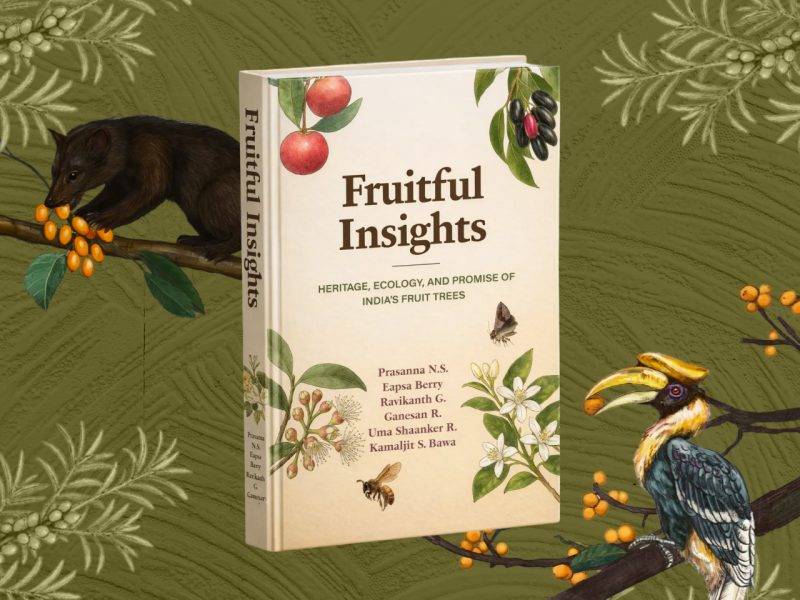
Details
Feb 01 2026 to Feb 01 2026 5:30 p.m.
EVENT HAS ENDED
Where
Bangalore International Centre
7 4th Main Rd, Stage 2, Domlur 560071
Event Description
When we pick a fruit in the bazaar or slice one open at home, we rarely pause to think about it beyond its taste. Yet inside that familiar fruit lies an extraordinary story that was shaped by millions of years of evolution, intricate ecological partnerships, centuries of human history, and layers of culture, belief, and science.
The story of fruits and fruiting trees begins deep in evolutionary time. Fleshy fruits evolved as ingenious biological strategies, forming partnerships with animals such as birds, bats, insects, fish, and primates. By offering sweetness, colour, and aroma, fruiting plants persuaded animals to pollinate flowers and disperse seeds, allowing forests to regenerate and spread. Many fruits still carry the signatures of these ancient relationships, including partnerships with species that no longer exist. Even today, wild and domesticated fruit trees play a vital ecological role, sustaining wildlife and supporting human communities.
Its not just forests, fruits even entered our myths, rituals, art, and language as powerful symbols of love, abundance, devotion, and prosperity. Mangoes, bananas, pomegranates, figs, and jamun trees appear in epics, festivals, temple carvings, poetry, songs, and everyday expressions. These cultural traces reveal that fruits did far more than nourish bodies. They shaped values, metaphors, memories, and ways of understanding the natural world. Fruits also travelled with people, quietly reshaping landscapes and diets. India is rich in the diversity of edible fruits and they are deeply connected to global exchange. Rulers and states invested in orchards and experimentation, treating horticulture as a serious pursuit tied to prestige, power, and knowledge. Fruit trees became markers of place, preserving geography and history in their names even as political borders shifted. During the last few centuries, botanical gardens, experimental farms, and public parks became testing grounds where fruit trees from across the world were introduced, studied, and distributed. These spaces reshaped what farmers grew and what people ate, linking plants to systems of governance, science, and economy.
Perennial fruit trees offer hope in a warming world. They support biodiversity, store carbon, stabilise soils, and build ecological and social resilience. By weaving together evolution, ecology, culture, history, and climate, this talk attempts to show that fruit trees are not just sources of sweetness. The talk attempts to invite everyone to see the humble fruit tree not just as food, but as a living thread that binds India’s landscapes, livelihoods, and legends.
With this programme, the Bangalore International Centre remembers the contributions of our member Vijay Thiruvady in three landmark lectures that he gave at the BIC, on the “Greening of Bangalore” with Girish Karnad and Capt. Prabhala (2015), on “Botanical Illustrations” with Nirupa Rao (2019), and on “Why Lalbagh Matters” (2021).
Among the accounts of our city, Vijay Thiruvady’s book, Lalbagh – Sultans’ Garden to Public Park, published by the Bangalore Environment Trust, presents the most comprehensive history of Lalbagh written to date. Ranging across five centuries, it presents a panoramic view from Kempegowda’s flower garden in 1537, through Haider and Tipu (1760 to 1799), to the East India Company years — Scottish army men and surgeons — and over a century by six Kew trained gardeners. The book is based on research from several archives, including Kew Gardens and the Royal Botanic Gardens Edinburgh, and of course on Vijay Thiruvady’s intimate knowledge of Lalbagh having conducted inspiring nature walks for over 18 years that were attended by over 15,000 walkers.
Vijay Thiruvady was always interested in various aspects of nature and more specifically horticulture. In addition to the Green Heritage Walks in Lalbagh, he conducted Imperial Colonial Walks in Cubbon Park and Military Heritage Walks at the MEG&C, and participated in the various activities of Bangalore Environment Trust as a Trustee. These have included the publishing of notable books on Heritage Trees in and around Bangalore and on Devarakadus and Gundutopus in the vicinity of Bangalore.
Thiruvady spent his early years in Delhi. His academic interests were pursued at
St. Stephen’s College, Delhi and School of Architecture, Ahmedabad. When in Delhi, he had exposure to the world of nature and environment through association with a number of distinguished people in the field and institutions.
He gave talks on Bangalore, its environment and history at many institutions, including the National Institute of Advanced Studies, Raman Research Institute, BIC, Bangalore Club, National Gallery of Modern Art, and Azim Premji University. A gifted raconteur, his encyclopedic knowledge of trees and of Bangalore’s history were conveyed through stories that kindled a love of nature and made his walks, lectures and books memorable, connecting with young and old from around the world, from experts in the field to school children. His passing in August 2023 is a profound loss to the city.
Vijay Thiruvady’s talk on Lalbagh at the BIC, which has been widely viewed as an introduction to the botanical garden and to Bangalore and its history, is available here.
His short essays on trees are available here.
An article about him in Frontline magazine is available here.
Tea will be served at 5 pm.
Speakers
Prasanna N S
Speaker | Postdoctoral Research Associate, ATREE
Dr. Prasanna N.S. is a plant biologist and Postdoctoral Research Associate at the Ashoka Trust for Research in Ecology and the Environment (ATREE), Bengaluru, India. His research focuses on edible plants and their ecological relationships.
Kamal Bawa
Co-Author & Discussant
Prof. Kamal Bawa is an evolutionary ecologist, conservation biologist and Distinguished Professor of Biology at the University of Massachusetts Boston and Founder-President of ATREE, He has conducted extensive research in the Himalayas on biodiversity conservation, climate change, and sustainable development.
Ravikanth G
Co-Author & Discussant
Dr. Ravikanth G. is a Senior Fellow at ATREE, Bengaluru, with over three decades of experience in population genetics and the application of molecular tools in tropical forest conservation and species recovery. A central theme of his work is the conservation and sustainable use of forest genetic resources, including fruit trees.
Uma Shaanker R
Co-Author
Prof. Uma Shaanker R. is an evolutionary ecologist and Professor Emeritus at the University of Agricultural Sciences, Bengaluru.. His research spans plant evolutionary biology, conservation genetics, bioprospecting, microbiomes, and data mining.
Eapsa Berry
Co-Author
Dr. Eapsa Berry is a botanist and evolutionary biologist at ATREE, Bengaluru. Her work spans plant morphology, systematics, phylogenetic comparative methods, and functional trait ecology, especially focusing on biodiversity and endemism in the Himalayas.
Ganesan R
Co-Author
Dr. Ganesan R. is a renowned botanist dedicated to documenting India’s plant diversity. He is a former Senior Fellow at ATREE, Bengaluru, and has made significant contributions to floristic research and plant taxonomy in India.
Upcoming events in Bangalore International Centre