How Do We Know The Universe?
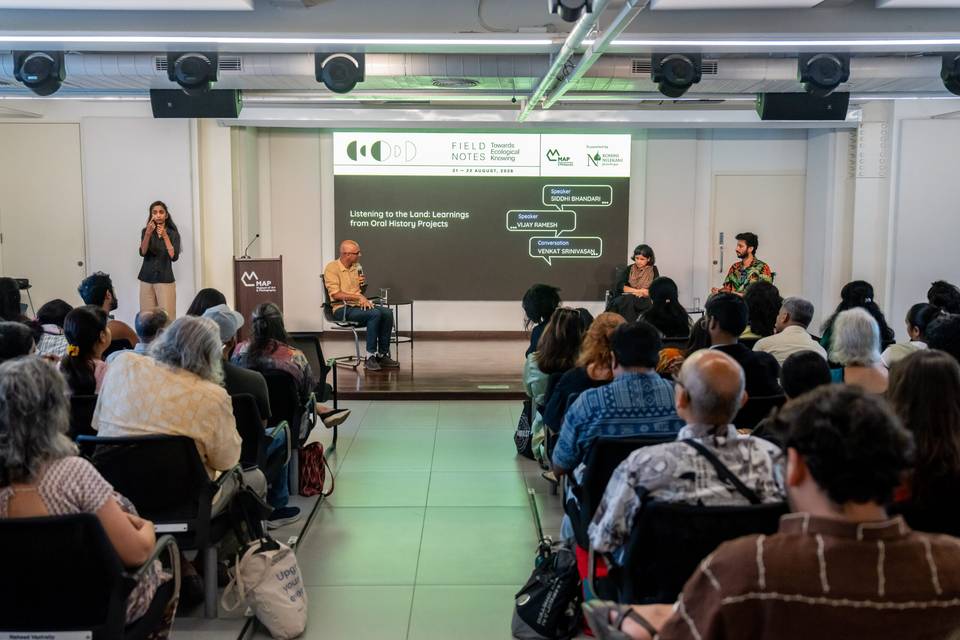
Details
Sep 05 2026 to Sep 05 2026 4:30 p.m.
EVENT HAS ENDED
Where
Museum of Art & Photography (MAP)
Kasturba Road, Bengaluru 560001
Event Description
A moderated conversation exploring knowledge systems that often remain outside textbooks, including community ecologies, urban land reading, and cultural practice. Moving through three questions—what it means to know the world from where one stands and whose standing has historically counted; what knowledge about the natural world exists in the city that dominant frameworks cannot see; and what might change in how the future is imagined if these other ways of knowing were taken seriously—the session invites audiences to briefly inhabit a world other than the one they walked in with.
This event is part of Plural Worlds, developed in collaboration with Lagori Collective and presented in conjunction with Beneath the Turning Sky.
Ovee H Thorat
Speaker
Ovee works on questions of power and justice in the field of wildlife conservation in India. Landscapes used extensively by pastoralists communities such as commons, drylands and Himalayan meadows have been the main sites of her work.
For her PhD, she worked in the Banni grasslands in Kutch, Gujarat, to identify the nature and impacts of various interventions made in the region for conservation and development of grasslands. She later studied how livestock keeping enables transitions in an SEZ in Andhra Pradesh. She has worked with Nature Classrooms in Kashmir as a fellow to create context-based nature learning resources with the local school teachers and educators. She was engaged with Anthra, a Pune-based NGO on gender dynamics in livestock-keeping communities and gender-sensitive research.
Prior to this she designed and co-taught a course on Environmental Communication for the undergraduate students at Krea University, Andhra Pradesh as a postdoctoral fellow. She also co-organised and conducted a workshop on Social Science Methods in Conservation Research at Student Conference on Conservation Science (SCCS), Bengaluru, India for five consecutive years. This enabled her to be an active member of the academic community in Bengaluru, which is something that she finds meaningful.
Other areas of her work include camera trapping of small carnivores, nature-literacy surveys, and plant-animal interactions. Gardening and art provides her with comfort and grounding.
Namrata Tiwari
Speaker
Namrata is a multidisciplinary designer and practice-led researcher working at the intersection of crafts, culture, and ecology. Her practice is shaped by her long-term engagement with communities and an interest in how craft can strengthen community resilience and place based livelihoods. She draws her design approach from her experience across fashion, human centered design and sustainable development.
She is the founder of Its All Folk, a grassroots design studio working in Western Arunachal Pradesh to create livelihood pathways rooted in traditional knowledge, cultural practices and ecological stewardship. Over the past several years, she has worked alongside the Brokpas, one of Arunachal Pradesh’s last semi-nomadic yak herding communities, exploring pastoralism, fibre economies and the knowledge systems that sustain them. Her current work focuses on understanding traditional knowledge and value systems through which communities care for their landscapes and livelihoods.
Dhaval Kothari
Moderator
Dhaval Kothari is a design researcher, foresight practitioner and co-founder of Lagori Collective, working on how systems are imagined and reshaped over time. His work draws from engagements across a range of institutional and community contexts, spanning Asia and Sub-Saharan Africa.
His practice is grounded in field-based research and participatory inquiry, working closely with communities and institutions to understand how people live through transitions. Working through a South Asian futures lens, he develops inquiries and frameworks that engage with the cultural, economic, and institutional conditions shaping long-term change.
Upcoming events in Museum of Art & Photography (MAP)
We don't have any upcoming events listed for this venue.
(Venue owners / event managers, to get your event listed, reach out to us.)